Website Speed Optimization for SEO: Why Faster Websites Rank Better
Website speed is no longer just a technical concern—it is a direct ranking factor and a major influence on user experience, engagement, and conversions.
Google prioritizes fast websites because users expect pages to load instantly. If your website is slow, visitors leave, bounce rates increase, and rankings decline—even if your content is strong.
For businesses in the UAE, where competition is high and mobile usage dominates, website speed optimization for SEO is essential for sustainable growth.
What Is Website Speed Optimization?
Website speed optimization is the process of improving how quickly your website loads and responds to user interactions.
From an SEO perspective, it ensures:
- Faster page load times
- Better user experience
- Improved Core Web Vitals
- Higher search engine rankings
Speed optimization is a core part of technical SEO, not a standalone task.
Why Website Speed Matters for SEO
Google has confirmed that page speed affects rankings on both desktop and mobile.
A slow website causes:
- Higher bounce rates
- Lower dwell time
- Poor Core Web Vitals scores
- Reduced crawl efficiency
Fast websites, on the other hand:
- Rank more consistently
- Convert better
- Retain users longer
Speed optimization improves both SEO performance and business results.
Website Speed and User Behavior
Studies consistently show that:
- Users abandon pages that take more than 3 seconds to load
- Every second of delay reduces conversions
- Mobile users are less patient than desktop users
In the UAE, where most searches happen on mobile networks, speed plays an even bigger role.
How Google Measures Website Speed
Google doesn’t rely on guesses. It measures real user experience through performance signals.
The most important are Core Web Vitals.
Read more: Core Web Vitals Explained
Core Web Vitals and Speed Optimization
Core Web Vitals are performance metrics that evaluate how users experience your website.
The Three Core Metrics
1. Largest Contentful Paint (LCP)
Measures how fast the main content loads.
2. Interaction to Next Paint (INP)
Measures how responsive the page feels when users interact.
3. Cumulative Layout Shift (CLS)
Measures visual stability during loading.
Speed optimization directly improves LCP and INP, while layout optimization improves CLS.
Common Causes of Slow Websites
Most speed issues come from avoidable technical problems:
- Unoptimized images
- Cheap or overloaded hosting
- Heavy WordPress themes
- Excessive JavaScript and CSS
- No caching or compression
- Too many third-party scripts
These issues silently damage SEO over time.
Website Speed Optimization Techniques That Work
Image Optimization
- Compress large images
- Use modern formats (WebP)
- Lazy-load below-the-fold images
Hosting Optimization
- Use high-performance hosting
- Enable server-side caching
- Reduce server response time
Code Optimization
- Minify CSS, JavaScript, and HTML
- Remove unused scripts
- Reduce render-blocking resources
Caching & Compression
- Browser caching
- GZIP or Brotli compression
- CDN implementation
These optimizations are usually handled during a technical SEO audit.
Read more: Technical SEO & Audit Services in UAE
Mobile Speed Optimization for SEO
Google uses mobile-first indexing, meaning your mobile speed matters more than desktop speed.
Mobile speed optimization focuses on:
- Lightweight layouts
- Fast mobile hosting
- Reduced script execution
- Touch-friendly elements
A website that loads fast on desktop but slow on mobile will still struggle to rank.
Mobile SEO Best Practices for UAE Websites
Website Speed Optimization and Crawling
Speed doesn’t just affect users—it affects Google’s crawl budget.
Fast websites:
- Get crawled more efficiently
- Index pages faster
- Experience fewer crawl delays
Slow websites waste crawl budget, limiting visibility.
How Speed Optimization Improves Rankings
When speed improves:
- Core Web Vitals scores increase
- Bounce rates decrease
- Engagement metrics improve
- Rankings stabilize and grow
Speed optimization multiplies the effectiveness of content SEO and backlinks.
Website Speed Optimization Checklist (SEO-Focused)
| Area | Check |
|---|---|
| Page Load Time | Under 3 seconds |
| Images | Compressed & optimized |
| Hosting | Fast server response |
| Caching | Enabled browser/server caching |
| Code | Minified CSS & JS |
| Mobile Speed | Optimized for mobile |
| Core Web Vitals | LCP, INP, CLS passed |
| Third-Party Scripts | Reduced & controlled |
| CDN | Implemented if needed |
This checklist is typically applied during a technical SEO audit.
Tools Used for Speed Analysis
- Google PageSpeed Insights
- Google Search Console
- Lighthouse
- GTmetrix
However, tools only identify problems—technical SEO fixes them correctly.
Speed Optimization vs Design
A visually attractive website doesn’t always mean a fast website.
Many design-heavy themes sacrifice:
- Speed
- Mobile usability
- SEO performance
Speed optimization balances design, performance, and rankings.
When Should You Optimize Website Speed?
You should prioritize speed optimization if:
- Rankings are declining
- Bounce rates are high
- Mobile traffic is weak
- Core Web Vitals fail
- Pages feel slow to users
In most cases, speed issues are uncovered during a technical SEO audit.
Website Speed Optimization as Part of Technical SEO
Speed optimization is not a one-time fix.
It requires:
- Ongoing monitoring
- Regular audits
- Updates after content or design changes
That’s why it’s included as a core part of Technical SEO & Audit Services.
Internal link: Technical SEO & Audit Services in UAE
FAQs (AI & Featured Snippet Optimized)
Does website speed affect SEO rankings?
Yes. Google uses page speed and Core Web Vitals as ranking factors.
What is a good page load time for SEO?
Ideally under 3 seconds, especially on mobile devices.
Can speed optimization improve conversions?
Yes. Faster websites reduce bounce rates and increase engagement and sales.
Is website speed more important on mobile?
Yes. Google uses mobile-first indexing and prioritizes mobile performance.
How often should speed optimization be checked?
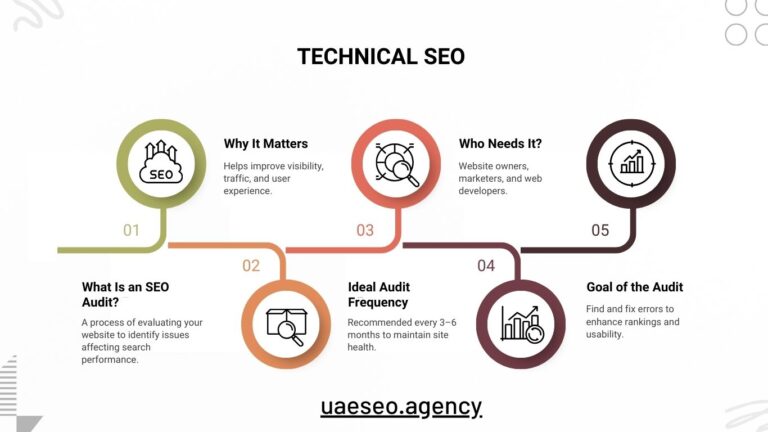
Every 3–6 months, or after major website updates.
Final Thoughts
Website speed optimization is not just a technical improvement—it’s a competitive advantage.
Fast websites rank better, convert better, and provide better user experiences.
If SEO performance is not improving despite content and backlinks, speed is often the hidden barrier.
That’s why speed optimization should always start with a technical SEO audit, followed by structured fixes.