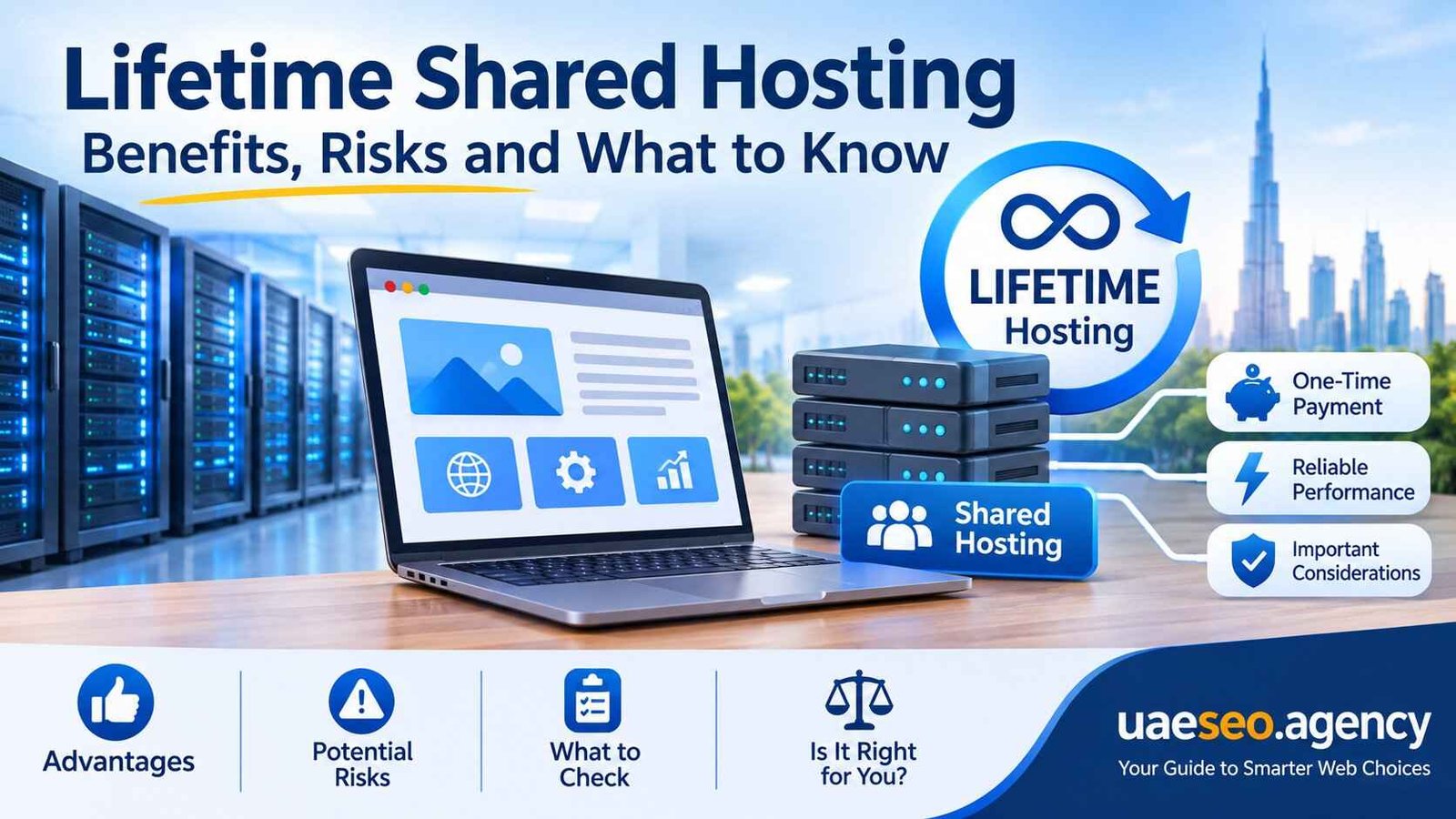
Lifetime Shared Hosting: Benefits, Risks and What to Know Before Buying
Choosing the right web hosting service is an important decision when launching a website. Whether you are creating a personal blog, a small business website, a portfolio or a WordPress project, hosting affects how your website is stored, accessed and maintained.
Traditional hosting services usually charge monthly or annually. However, another option has attracted attention: lifetime shared hosting. Instead of paying a recurring base hosting fee, customers pay once for a hosting plan that is advertised as lasting for its defined lifetime.
At first glance, this sounds like an excellent way to reduce website expenses. But what does lifetime shared hosting actually include? Does lifetime mean forever? Can you host multiple websites? Are there additional fees? And is this type of hosting suitable for a business website?
This guide explains how lifetime shared hosting works, its advantages and disadvantages, potential costs, and the important things to check before purchasing a plan.
Safety and information note: uaeseo.agency is an independent informational hub. This article provides general educational information about web hosting and does not represent a hosting provider or guarantee the performance, availability or lifetime of any hosting service. Always review the provider’s current terms before purchasing.
What Is Lifetime Shared Hosting?
Lifetime shared hosting is a web hosting arrangement in which a customer makes a one-time payment for shared hosting services covered by a provider’s lifetime offer.
To understand this concept, it helps to separate its two main parts:
- Shared hosting: Multiple websites or customer accounts use resources from the same physical server or hosting infrastructure.
- Lifetime hosting: The provider advertises a one-time payment for hosting that continues for a defined service lifetime, subject to its terms and conditions.
In traditional shared hosting, customers typically pay monthly or annually to keep their hosting accounts active. With a lifetime shared hosting offer, the base hosting fee is paid upfront instead of being charged repeatedly.
However, the word lifetime does not have one universal meaning across hosting providers. It may refer to the commercial lifetime of a product or service, the provider’s continued operation, or another definition written into the contract.
For example, one provider may define lifetime hosting as the period during which its lifetime hosting service remains commercially available. Another provider may use a different definition.
Therefore, a one-time payment should not automatically be understood as a promise that your website will remain hosted forever.
How Does Lifetime Shared Hosting Work?
Lifetime shared hosting generally follows a process similar to regular shared hosting, except that the initial hosting payment is structured differently.
Here is how it typically works.
Step 1: Choose a lifetime hosting plan
The customer visits a hosting provider’s website and selects a lifetime shared hosting package.
Before purchasing, review the plan specifications, including:
- Storage capacity
- Bandwidth or data-transfer policy
- Number of websites allowed
- Database limits
- CPU and memory allocations
- Email hosting availability
- Control panel access
- Backup arrangements
- Support coverage
Do not choose a package based only on its advertised storage or one-time price. Resource limits and service conditions are equally important.
Step 2: Make the one-time payment
After selecting a plan, the customer pays the advertised upfront hosting fee.
The payment may cover the base hosting service for the duration defined in the provider’s lifetime policy. It does not necessarily include domain registration, premium software licences, additional storage, dedicated IP addresses or other services.
Step 3: Connect your domain
You need a domain name for visitors to access your website through an easy-to-remember web address.
If you already own a domain, you can usually connect it by updating the nameservers or DNS records as instructed by your hosting provider.
If you do not own a domain, you may need to register one separately. Check whether the provider includes a domain promotion and how much renewal will cost after the initial registration period.
Step 4: Install your website
After activating the hosting account, you can upload your website files or install a supported content management system such as WordPress.
Many shared hosting services provide a control panel and application installer to simplify website management.
Depending on the plan, you may be able to manage:
- Website files
- MySQL databases
- Email accounts
- Subdomains
- SSL certificates
- Backups
- DNS-related settings
The available features depend on the hosting provider and its selected package.
Step 5: Manage and maintain your website
Once your website is online, you remain responsible for many aspects of website management.
This includes updating your CMS, maintaining plugins, securing login accounts, checking backups and monitoring website performance.
Lifetime hosting does not automatically mean lifetime website maintenance. Unless explicitly included in the agreement, updates, development, troubleshooting and other professional services may cost extra.
What Is the Difference Between Lifetime Shared Hosting and Regular Shared Hosting?
The main difference is the payment structure and the service duration defined by the provider.
| Feature | Lifetime shared hosting | Regular shared hosting |
|---|---|---|
| Initial payment | Usually one-time | Usually recurring |
| Hosting renewal | Depends on lifetime terms | Monthly or annually |
| Server resources | Shared | Shared |
| Website management | Depends on plan | Depends on plan |
| Domain registration | May cost extra | May cost extra |
| Backups | Provider-specific | Provider-specific |
| Support | Provider-specific | Provider-specific |
| Service duration | Defined by lifetime policy | Usually tied to active subscription |
Both hosting types use shared infrastructure. Neither automatically guarantees better speed, security or uptime.
For example, a regular shared hosting provider may offer more resources, stronger support commitments or a clearer upgrade path than a lifetime hosting provider. On the other hand, a lifetime plan may reduce recurring base hosting payments if the provider continues delivering the service under its agreed terms.
The right option depends on the website’s requirements and the risks you are willing to accept.
What Are the Advantages of Lifetime Shared Hosting?
Lifetime shared hosting can offer several advantages, particularly for website owners who want predictable initial hosting expenses.
1. One-time base hosting payment
The most obvious attraction is the possibility of paying once rather than paying a recurring base hosting fee.
For someone running a small website, this may make budgeting easier.
However, remember that other expenses, such as domains, premium licences, email services and optional upgrades, may still require recurring payments.
2. Suitable for small websites
Shared hosting is commonly used for smaller websites that do not require dedicated server resources.
Examples include:
- Personal blogs
- Portfolio websites
- Informational websites
- Small business websites
- Basic WordPress websites
- Small community projects
Whether a lifetime plan is appropriate depends on its resource limits and the provider’s support arrangements.
3. Beginner-friendly website management
Many shared hosting plans offer a graphical control panel, file manager, database tools and one-click application installers.
These features can help beginners manage a website without needing advanced server administration skills.
The exact control panel and available tools vary by provider.
4. Reduced recurring hosting expenses
If the provider continues offering the service for a sufficiently long period, a one-time hosting payment may cost less than repeatedly purchasing comparable subscription hosting.
However, this is not guaranteed. You need to compare the full cost, including additional fees and the actual period of service received.
5. Convenient for long-term projects
A suitable lifetime hosting plan may be convenient for a small website that has stable requirements and does not need frequent resource upgrades.
Before relying on it for a long-term project, make sure the provider clearly explains service continuity, data recovery and migration arrangements.
What Are the Disadvantages of Lifetime Shared Hosting?
Although the one-time payment can be attractive, lifetime shared hosting has limitations that buyers should understand.
1. The meaning of lifetime can be restricted
The biggest concern is the definition of the word lifetime.
Some providers define it according to the commercial life of their hosting product or service. Others may have different conditions concerning infrastructure, account eligibility or service termination.
This means the actual duration may be different from what a customer initially assumes.
Always read the lifetime hosting policy, terms of service and checkout conditions before purchasing.
2. Shared server resources are limited
In shared hosting, several customers use the same server infrastructure.
A hosting provider must allocate resources to maintain server stability. These may include:
- CPU usage
- RAM
- Storage
- Database capacity
- Entry processes
- File or inode limits
- Network resources
A plan advertised with generous or unlimited features may still have fair-use conditions and technical limits.
For example, hosting agreements may restrict resource consumption or require an upgrade when a website exceeds its allocated limits like Hostinger.
3. The provider may stop offering the service
A hosting business must continue paying for servers, electricity, network connectivity, maintenance, security and technical support.
A one-time customer payment does not remove these ongoing operating costs.
If the provider closes its business, discontinues the lifetime product or terminates the service under its terms, your website may need to move elsewhere.
This is why independent backups and a practical migration plan are essential.
4. Future upgrades may cost extra
Your website may grow over time.
A small blog might initially use very little storage and processing power. As you publish more content, receive more visitors or add new features, resource requirements can increase.
A lifetime shared hosting plan may not include unlimited upgrades. Additional resources, advanced support or a move to a different hosting environment may involve additional charges.
5. Support quality can vary
Some providers offer extensive technical support, while others restrict support to basic account and server issues.
Before buying, find out:
- Whether support is available 24/7
- Which contact methods are offered
- Whether technical support is included
- Whether WordPress troubleshooting is covered
- Whether website migration is included
- Whether response times are guaranteed
Do not assume that a one-time hosting purchase includes unlimited technical assistance.
Is Lifetime Shared Hosting Really Lifetime?
This is one of the most important questions to ask before buying.
Lifetime shared hosting does not automatically mean hosting for the customer’s entire lifetime or permanent access to a server.
The provider’s agreement determines what the word means.
Consider these possible definitions:
| Definition | What it could mean |
|---|---|
| Product lifetime | Hosting continues while the product is commercially offered |
| Service lifetime | Hosting continues while the provider operates that service |
| Infrastructure lifetime | Service duration may be connected to the operating life of specified infrastructure |
| Contract-defined period | The provider specifies a particular duration or other conditions |
These are examples of possible contract definitions, not a universal industry standard.
For example, LifetimeHosting.tech describes its lifetime hosting as a one-time purchase of base hosting capacity and defines lifetime around the commercial operating lifetime of its service. It also distinguishes the hosting entitlement from items such as domains, premium licences and additional capacity. LTHost
Before making a purchase, look for direct answers to these questions:
- What exactly does lifetime mean?
- What happens if the company stops operating?
- Can the provider discontinue the lifetime product?
- Is there a guaranteed minimum service period?
- Will customers receive notice before termination?
- Can website files and databases be exported?
- Is migration assistance included?
If the provider does not clearly explain these conditions, consider that a warning sign.
Does Lifetime Shared Hosting Include a Free Domain?
Not necessarily.
Hosting and domain registration are separate services.
A hosting plan provides server space and the infrastructure needed to make your website accessible. A domain name provides the address visitors use to reach it.
Some hosting providers may include a free domain for an initial registration period, but this does not automatically mean the domain is free forever.
For example, a promotional package might include domain registration for the first year, followed by an annual renewal fee.
Before purchasing, check:
- Whether domain registration is included
- Which domain extensions are eligible
- How long the promotion lasts
- What the renewal price is
- Whether you can transfer the domain
- Who controls the domain registration account
For important business websites, maintaining control over your domain registration is particularly important.
Is Lifetime Shared Hosting Good for WordPress?
Lifetime shared hosting can be suitable for some WordPress websites, provided the server supports the software requirements and offers enough resources.
WordPress websites typically need a compatible PHP environment, a supported database system, storage and sufficient server resources.
Before installing WordPress, check the hosting provider’s technical specifications and current WordPress requirements.
Also review these features:
- WordPress installation tools
- PHP version selection
- Database limits
- SSL certificate availability
- Backup and restore options
- Security features
- File and CPU restrictions
- Support for WordPress-related issues
A small informational WordPress blog may work well on a suitable shared hosting plan. A busy WooCommerce store, membership platform or high-traffic website may need more resources or managed hosting.
Do not assume that every lifetime shared hosting package is optimized for WordPress.
Lifetime Shared Hosting vs VPS Hosting
Lifetime shared hosting and VPS hosting are designed for different levels of website requirements.
| Feature | Lifetime shared hosting | VPS hosting |
|---|---|---|
| Infrastructure | Shared server environment | Virtual private server |
| Resource allocation | Shared with account limits | Allocated virtual resources |
| Server control | Usually limited | Greater administrative control |
| Technical management | Often beginner-friendly | May require more technical knowledge |
| Scalability | Depends on plan | Often offers more upgrade flexibility |
| Best suited for | Smaller websites | More demanding projects |
A VPS is not automatically better for every website. It may provide more control and dedicated virtual resources, but it can also require additional technical management.
For a small website, shared hosting may be sufficient. For a growing application, online store or resource-intensive project, a VPS or cloud hosting solution may be more appropriate.
How to Choose a Reliable Lifetime Shared Hosting Provider
Choosing a provider requires more than comparing one-time prices.
Use the following checklist before making a decision.
1. Read the terms and conditions
Find the provider’s official lifetime hosting policy.
Look for its definition of lifetime, service termination conditions, refund rules and any rights to modify or discontinue the service.
2. Check server resource limits
Do not rely only on words such as unlimited storage or unlimited bandwidth.
Check the actual limits for CPU, RAM, storage, databases, file counts and website numbers.
Resource restrictions are common in shared hosting because providers need to maintain fair server usage across accounts check Namecheap.
3. Review uptime commitments
Look for a written service-level agreement, if one is offered.
Check whether an uptime percentage is a contractual guarantee or simply a performance target.
A useful SLA should explain what is measured, which interruptions are excluded, how claims are submitted and what remedy is available.
4. Understand backup arrangements
Backups are essential for protecting website files and databases.
Ask:
- How often are backups created?
- How long are they retained?
- Are databases included?
- Are email accounts included?
- Can customers restore backups themselves?
- Are restoration fees charged?
- Can you download your own backups?
Maintain independent copies rather than relying entirely on the hosting provider’s backup system.
5. Test customer support
Before purchasing, contact the provider with a technical question.
This can help you understand how it handles customer enquiries.
Check whether support is provided through live chat, email, tickets or phone and whether the advertised support hours apply to your selected plan.
6. Check migration and exit options
A reliable hosting arrangement should allow you to understand how to move your website if the service ends or no longer meets your needs.
Confirm that you can obtain your website files, databases and other essential data in usable formats.
Do not wait until a problem occurs to discover that exporting or migrating your website is difficult.
7. Calculate the complete cost
A one-time hosting price may not include every website-related expense.
Consider the following:
- Domain registration and renewal
- Premium SSL certificates, if needed
- Email services
- Additional storage
- Premium software licences
- Backup services
- Migration assistance
- Technical support
- Taxes and transaction fees
Compare the full cost over a realistic period instead of looking only at the initial payment.
Is Lifetime Shared Hosting Worth It?
The answer depends on your website, the provider and the conditions of the offer.
Lifetime shared hosting may be worth considering when:
- You operate a small personal or informational website.
- The hosting limits match your needs.
- The provider has clearly written service terms.
- You understand what the one-time payment includes.
- You maintain independent backups.
- You can move your website if necessary.
It may be less suitable when:
- Your website generates significant business revenue.
- You operate a high-traffic online store.
- You store important customer information.
- You need guaranteed technical support.
- Your website requires dedicated resources.
- Downtime would cause substantial financial loss.
For a business-critical website, reliability, support, backup protection and recovery arrangements should carry more weight than a discounted one-time price.
There is no universal rule that lifetime hosting is always cheaper or less reliable than subscription hosting. The decision should be based on the actual contract, service quality, full costs and your ability to recover or migrate your website.
How to Calculate Whether a Lifetime Hosting Plan Saves Money
You can estimate the potential savings by comparing the lifetime hosting price with the cost of an equivalent subscription plan.
For example, assume:
- Lifetime hosting payment: AED 500
- Comparable annual hosting subscription: AED 200
The simple break-even calculation is:
\[ \text{Break-even period} = \frac{\text{One-time payment}}{\text{Annual subscription cost}} \]
\[ = \frac{500}{200} = 2.5\text{ years} \]
Example cost comparison
Lifetime plan
AED 500
One-time base payment
Annual plan
AED 200
Per year
Simple break-even point
2.5 years
Illustrative calculation only. Assumes equivalent services and excludes domains, taxes, add-ons, price changes and service interruption.
This calculation does not prove that the lifetime plan is better. If the provider discontinues the service after two years, the customer may not receive the expected long-term value.
The calculation is useful only when the hosting services being compared are genuinely similar.
Common Mistakes to Avoid When Buying Lifetime Hosting
Choosing only by price
A low one-time payment does not guarantee good performance, security or customer support.
Assuming unlimited means unlimited
Always read the fair-use policy and technical resource limits.
Ignoring domain renewal fees
Your domain may still require annual renewal even if the hosting base fee is paid once.
Not maintaining independent backups
A hosting provider’s backups should not be your only protection against data loss.
Ignoring the refund policy
Check the refund period, eligibility requirements and cancellation conditions before paying.
Using an unsuitable plan for a growing business
A shared hosting package may not provide enough resources for a large online store or demanding application.
Failing to check ownership and migration rights
Make sure you control your domain and can retrieve your website files and databases if you need to change providers.
Conclusion
Lifetime shared hosting can be an attractive option for website owners who want to reduce recurring base hosting payments. It may suit personal blogs, small informational websites and other projects with modest resource requirements.
However, the word lifetime should never be accepted without checking the provider’s actual terms. Service duration, resource limits, backups, support, domain renewal and additional charges can all affect the real value of the offer.
Before purchasing, compare the hosting specifications, understand the service agreement, calculate the full cost and maintain independent backups.
Ultimately, the best hosting choice is not necessarily the one with the lowest upfront price. It is the one that provides the right combination of performance, reliability, security, support and long-term flexibility for your website.
Frequently Asked Questions About Lifetime Shared Hosting
1. What is lifetime shared hosting?
Lifetime shared hosting is a hosting plan advertised with a one-time payment for shared server hosting during a provider-defined service lifetime. Its actual duration and included features depend on the provider’s terms.
2. Is lifetime shared hosting really lifetime?
Not necessarily. Providers define the term differently. It may refer to the commercial lifetime of a product or service rather than the customer’s natural lifetime. Always read the official policy.
3. Can I host WordPress on lifetime shared hosting?
Yes, if the provider supports the required WordPress software environment and offers sufficient storage, databases and server resources. Check the plan specifications before purchasing.
4. Does lifetime hosting include a free domain?
Not always. Some providers include a domain promotion for an initial period, but domain registration and renewal may be separate expenses.
5. Is lifetime shared hosting better than monthly hosting?
Neither option is automatically better. Lifetime hosting may reduce recurring base fees, while monthly hosting can offer more flexibility to cancel or change providers. Compare the full cost and service conditions.
6. Can I host multiple websites on lifetime shared hosting?
That depends on the selected package. Some plans allow multiple websites, while others restrict the number of domains or websites. Check the exact account limits.
7. Does lifetime shared hosting include SSL certificates?
Some providers include SSL certificates, while others offer them as paid features or through separate services. Check whether SSL is included and whether renewals are automatic.
8. What happens if a lifetime hosting provider shuts down?
Your website may become inaccessible, and you may need to move it to another provider. Maintain independent backups of website files and databases so you can recover your content.
9. Is lifetime shared hosting suitable for an online store?
It may be suitable for a small store if the resources, security, backups and support are adequate. For a high-traffic or business-critical store, consider more scalable hosting and stronger service commitments.
10. Can I upgrade lifetime shared hosting later?
Some providers offer paid upgrades or additional resources, while others restrict upgrades on lifetime packages. Confirm the upgrade policy before purchasing.
11. Does lifetime hosting mean no future payments?
No. The base hosting fee may be paid once, but domains, premium licences, additional resources, email services, backups and other features may require separate payments.
12. Should beginners buy lifetime shared hosting?
Beginners can consider it for small websites, but they should first understand the provider’s terms, technical limits, support arrangements and backup options. A familiar subscription plan may be preferable if flexibility and straightforward cancellation are more important.
Safety Note: uaeseo.agency is an independent informational hub providing educational content about web hosting and technology. We aim to share helpful and accurate information, but hosting plans, features, prices, and service terms may change. Always review the hosting provider’s official terms, renewal conditions, resource limits, backup policies, and support details before purchasing a lifetime hosting plan.